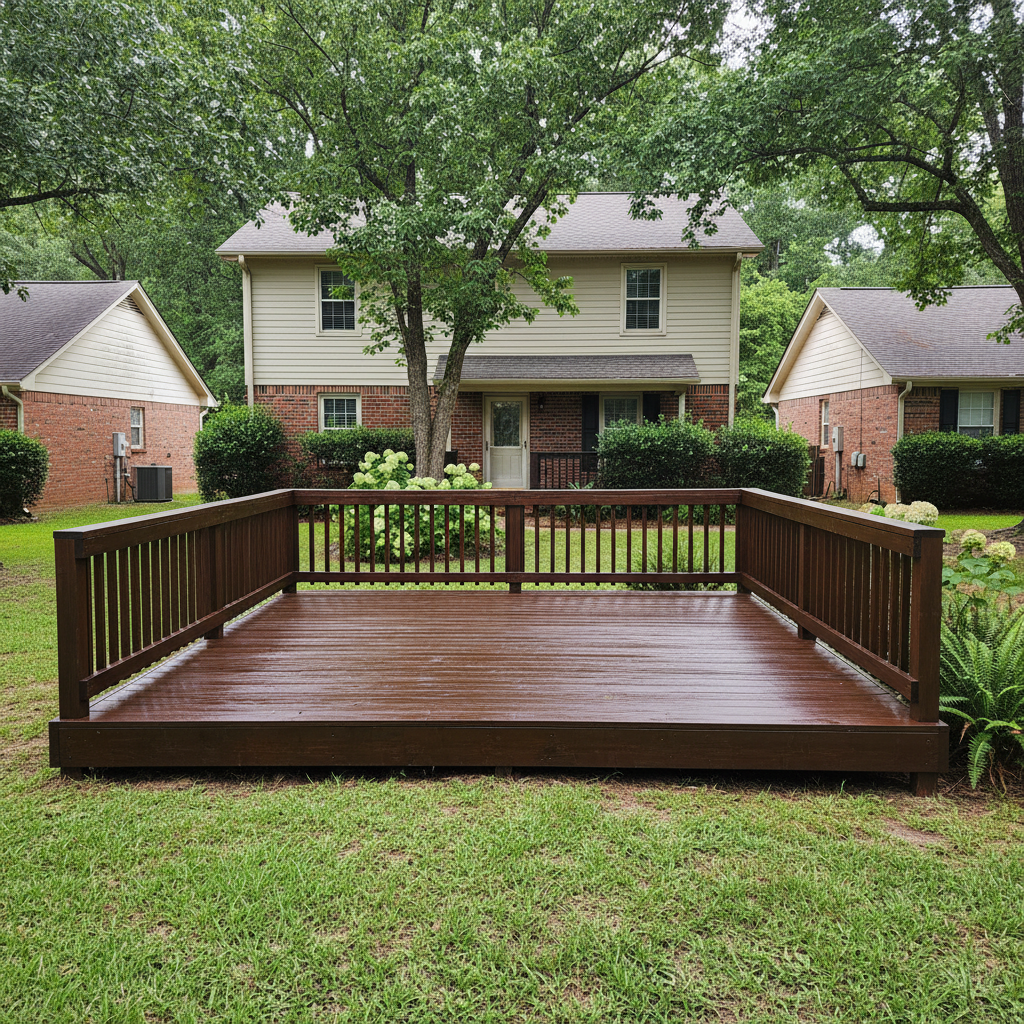
Olive Branch has a lot of decks going up right now. New subdivisions off Goodman Road and Pleasant Hill, older houses near downtown getting a deck added for the first time, people replacing something that's been rotting quietly for fifteen years. With that much work happening, there are a lot of trucks with a magnetic sign on the door and not much behind it. Here's what actually separates a deck builder worth hiring from one you'll be calling back in two years about a wobbly post.
Ask about the footings before you ask about the railing style
Everybody wants to talk about composite color and cable rail. Ask about the hole in the ground instead. DeSoto County sits on a lot of red clay, and clay does two things that matter for a deck: it holds water after a storm and it shrinks hard when we get a dry August. A footing that isn't dug deep enough, or isn't sitting on undisturbed soil, will move with that cycle. The post on top of it moves too, and a few years later you've got a deck that bounces or a railing that leans.
A builder who knows the ground here should be able to tell you the footing depth they're planning without pausing, and it should be below the frost line, typically at least 12 inches in this part of Mississippi, often deeper depending on the span and the load. If they shrug and say "we just dig it till it feels right," that's not an answer, that's a guess with a shovel.
Check the license and the insurance, not just the truck
Ask for proof of general liability insurance and workers' comp coverage before anyone sets foot on your property. If a framer falls off a ladder on your job and the company has no coverage, that liability can land on you as the homeowner. A legitimate deck builder hands this over without making it weird. One who gets cagey about it, or says "we've never needed it," is telling you something true about how they run jobs.
It's also fair to ask how long they've been building decks specifically, not just doing general carpentry. Framing a deck that carries snow load, foot traffic, a hot tub, or a grill station for twenty years is a different job than hanging a door.
Permits aren't optional, even if the last guy skipped them
Most deck projects in Olive Branch and the surrounding county need a building permit, and that permit usually comes with at least two inspections: one on the footings and framing before the decking goes down, and one closer to final, especially if railing height and stair rise are part of the job. If your lot is in a newer subdivision, there's a decent chance an HOA also wants to see the plan before work starts, since a lot of those neighborhoods have design rules about what's visible from the street.
A builder who tells you "we don't bother pulling permits, it slows things down" is saving themselves paperwork and handing you the risk. Unpermitted decks show up during home inspections when you go to sell, and in some cases the buyer's lender will require it be brought up to code before closing. That's a bad time to find out the ledger board was never flashed correctly.
Ask what changes between wood and composite here
Pressure-treated pine is still the most common deck frame in this area, and it's a fine choice, but it needs to breathe and it needs real gaps between boards, usually around 1/8 to 3/16 inch, because our humidity swings hard between a wet spring and a dry late summer. A deck built tight in April can cup or buckle by August if nobody accounted for that movement.
Composite decking handles moisture better and won't rot, but it expands and contracts with heat more than people expect. Mississippi summers push surface temperatures on a dark composite board well past 140 degrees in direct sun, so fastener spacing and expansion gaps matter more, not less, than with wood. If a builder quotes composite and installs it exactly like they'd install pine, that's a corner being cut.
Staining and sealing has its own weather window here too. You want at least 48 hours of dry weather after application, and our spring thunderstorm pattern makes that harder to plan around than it sounds. A builder who schedules a stain job the same week as a 60% chance of afternoon storms either doesn't check the forecast or doesn't care if it has to be redone.
What to walk away from
- A quote with no mention of footing depth, post spacing, or joist size, just a total price.
- Pressure to sign the same day, especially with a "today only" discount.
- Payment demanded entirely upfront, in cash, with no written contract.
- No answer when you ask who pulls the permit.
- A ledger board plan that involves nailing into the siding without flashing or lag bolts into the rim joist. This is the single most common cause of deck collapse, and it's almost always invisible once the decking is down.
None of this has to feel adversarial. A builder who's done this work for years in this county will answer these questions in plain language without getting defensive, because they've had to explain it to homeowners before. If you're weighing a new build, a repair, or just trying to figure out if your current deck is salvageable, you can see the kind of work we do and how we approach it at Heritage Deck Solutions.